9 June 2026
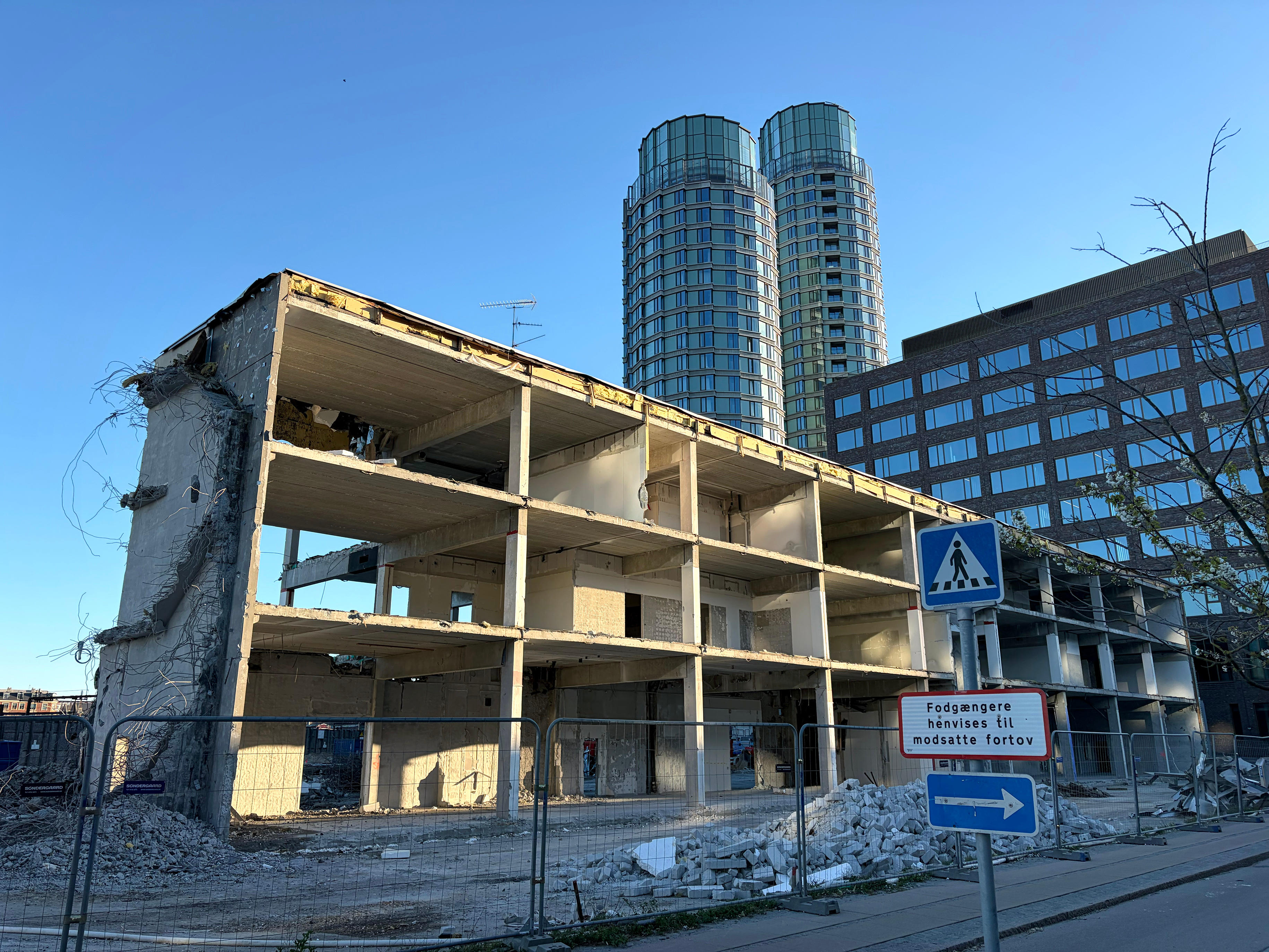
During the demolition of a former warehouse building in the heart of Copenhagen, the work is being carried out with considerably more care than is typically seen elsewhere. DSB is focused on the circular use of resources, giving old materials a new life in future projects.
Two men carefully lift a large window unit away from the building and carry it over to a stack of similar panes. Glass that has been fixed in a concrete façade for decades is now being prepared to find a new purpose elsewhere.
The scene is unfolding on Carsten Niebuhrs Gade, a stone's throw from Copenhagen Central Station. This is where DSB is demolishing a former office and warehouse building as part of the development of Postbyen – a new urban district in the heart of Copenhagen.
But this is no ordinary demolition. Even though the excavators are well underway, the work is being carried out more carefully than usual. Materials are not simply being crushed and carted away. To a large extent, they are being sorted, cleaned, and stored.
"It is certainly not the cheapest solution." – Claus Obel Skovgaard, Chief Project Developer at DSB Ejendomsudvikling
Demolition with care
In total, 400 m² of Corten steel panels, 900 m² of aluminium façade panels, and 180 windows are among the items being removed and prepared for reuse. In addition, investigations are underway into whether the large concrete floor slabs can be reused – a process that requires considerably more work than traditional demolition.
"It is certainly not the cheapest solution. But it is the right solution for us, because we want to reuse as many materials as possible out of consideration for the environment and the climate," says Claus Obel Skovgaard, Chief Project Developer at DSB Ejendomsudvikling.
The materials will be stored by DSB and later used in new construction projects – including in Jernbanebyen in Copenhagen – as well as in road surfaces and green areas.
A new way of demolishing
For the tradespeople on site, this means a different kind of working day. Here, it is not just about speed, but about precision. It is an approach that is gaining increasing traction.
"We see resources when we remove a building like this. The materials still have value, and ensuring the highest possible level of reuse is the future of our industry," says machine operator Jesper Randrup from the demolition company Søndergaard.
He estimates that it will take around a month to remove the building – significantly longer than a traditional demolition.
Parts of the building's interior have also been given a new lease of life, he adds. Ventilation systems and fittings have been sold on for reuse, among other things.
Part of a larger plan
The demolition here is the first step in the final phase of the development of Postbyen, which DSB Ejendomsudvikling is leading in collaboration with Danica Ejendomme.
On DSB's part of Postbyen, there will be room for, among other things, 91 social family housing units and 195 youth housing units. In addition, an office building of 5,500 m² will be constructed.
All the buildings will meet high sustainability standards and will be gold-certified under the DGNB scheme, in which the circular use of materials counts positively, says Claus Obel Skovgaard.
"It requires more work to remove the materials individually, but in return they can be used again instead of ending up as waste," says Claus Obel Skovgaard.
"At DSB, we focus on the circular use of resources, which is good for the environment and the climate." –Aske Mastrup Wieth-Knudsen, Head of Sustainability at DSB
A new way of thinking
When Postbyen is completed in 2029, the area will present itself as a new, green urban district in the heart of Copenhagen. The demolition on Carsten Niebuhrs Gade is therefore not only the end of a building from the 1970s – but the beginning of a new way of thinking about construction, where materials are not waste, but resources.
This is precisely the mindset that DSB has been embracing for a number of years now. That is according to Aske Mastrup Wieth-Knudsen, Head of Sustainability at DSB. He explains that, from a CO₂ perspective, the direct reuse of materials is the best option, and that in cases where this is not possible, it is important to ensure that raw materials such as glass and steel are recycled in other ways.
"At DSB, we focus on the circular use of resources, which is good for the environment and the climate. The alternative to reusing usable materials is that new materials have to be produced and transported. As a responsible company, this makes sense for us, and with rising raw material and energy prices, it is also increasingly making economic sense," he says.
Common sense
In addition to building materials from old structures, DSB also refurbishes and reuses worn work uniforms, and when DSB's train staff received new blue uniforms a few years ago, the old ones were transformed into, among other things, tabletops and acoustic panels.
To ensure that DSB can achieve an even higher degree of direct material reuse in the future, the company focuses – both in construction and in the procurement of new trains – on ensuring that the materials in both buildings and trains can be disassembled when they are no longer needed.
"It is common sense, but the more mixed the materials are, the harder they are to separate and recycle. That is why it needs to be considered from the very beginning, and it is crucial for us. For example, we have purchased new trains where a very large proportion of the train can be recycled when the time comes to phase them out," concludes Aske Mastrup Wieth-Knudsen.