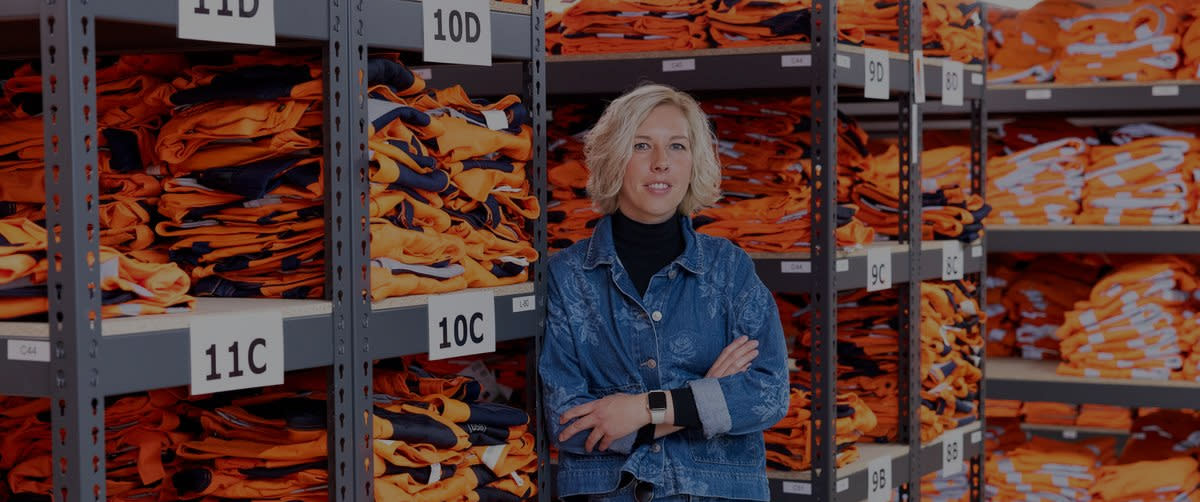
By giving used workwear a new lease of life, DSB avoids discarding textiles that are still in good condition. At the same time, it sends an important signal that sustainability is a natural part of working at DSB.
It's not rocket science. On the other hand, it's easier said than done — since September this year, DSB has begun letting craftsmen and station staff take over used workwear rather than automatically buying new.
While the clothing — primarily orange workwear — from former employees can easily be reused, the coordination and inventory management itself requires both resources and time when it involves clothing for over 1,000 employees.
Fortunately, DSB has Camilla Ørsted Nielsen. She is a workshop coordinator at Depotvej in Taastrup, where the maintenance of S-trains is also carried out. Here, her job is to make sure both new and experienced colleagues are well equipped.
"Camilla's clothing store" has indeed been written on the table in the storage room for reused clothing by some kind souls — and it's not entirely wrong. Since the turn of the year, she has been tasked with sorting and managing the inventory of thousands of used pieces of workwear and integrating them into DSB's SAP system.
"It has taken a great effort to get the logistics under control. But it makes really good sense, because there's nothing wrong with the clothing, and it would be a shame not to reuse it..."
Camilla Ørsted Nielsen, workshop coordinator
Saving on starter packs
Now the work is complete, and the used workwear — approximately 7,000 items in total — is neatly arranged on rows and shelves, so all types and sizes can be quickly found.
"It has taken a great effort to get the logistics under control. But it makes really good sense, because there's nothing wrong with the clothing, and it would be a shame not to reuse it," she says, adding that there are several interesting savings to be made for DSB.
Previously, all newly hired craftsmen and station staff received a starter pack containing 28 pieces of new workwear consisting of trousers, T-shirts, jumpers, jackets, etc., at a cost of approximately DKK 7,000.
By reusing the clothing, such a pack now costs around DKK 1,000. In September alone, Camilla prepared 20 starter packs — plus individual items for employees who needed something replaced.
And that makes a difference in more ways than one.
A brilliant solution
The shift from new to used not only saves DSB DKK 667,200 annually in purchasing costs, but also delivers a CO₂e saving of approximately 183 tonnes — equivalent to the production of 152,500 litres of milk.
"When we have so much used clothing — much of it practically brand new — there's no reason to buy new before we actually need it," says Camilla Ørsted Nielsen, adding that colleagues who wear the clothing on a daily basis are broadly positive about the initiative.
"Some need a little time to get used to not receiving a brand-new pair of trousers when their old ones wear out. But people understand the reasoning, and as long as the clothing is in decent condition, they're happy with the arrangement," she says.
That also applies to maintenance technician Anton Stigfeldt, who works on keeping DSB's S-trains running in the best possible condition.
"I think it's a brilliant solution, because it's just workwear that gets dirty when we use it anyway. Whether it's been worn before doesn't matter, as long as it fits and works as it should," he says.
An important effort
By 2030, DSB has an environmental target to reduce the climate impact from its own operations by 98 percent. And while reusing workwear in a company of DSB's size may not make the biggest difference in the overall CO₂ balance, it is still an important effort, says Aske Mastrup Wieth-Knudsen, Head of Sustainability at DSB.
"Reusing clothing is important to us because we are responsible for our use of resources. Both internally and externally, it sends a signal that sustainability is a core value at DSB. And that applies across the board," he says, adding that DSB also recycles blue uniforms into, among other things, acoustic panels and tabletops.
And while recycling is good, reuse is better when it is possible, says Aske Mastrup Wieth-Knudsen. He is therefore proud and pleased that DSB has prioritised getting the most out of the used workwear that, until Camilla took it on, had simply been sitting forgotten in a warehouse.
"To reach our environmental targets, we need good ideas from across DSB, and the reuse of workwear is very welcome as inspiration for other areas where the thinking behind it might also be scaled up," he concludes.